
The question everyone has at the start of a kitchen renovation and almost no one gets a straight answer to. Supplier quotes vary wildly. Online "cost guides" are populated with figures so broad they're almost meaningless. And the gap between what a kitchen looks like in a showroom and what it costs to replicate in a real home can be genuinely shocking.
This guide cuts through that ambiguity — not with false precision, but with the framework for understanding where modern kitchen cupboard costs actually come from, how to evaluate what you're being quoted, and where intelligent budget allocation makes a real difference.

What Three Price Points Actually Buy You
Modern kitchen cupboards span a price range that can feel incomprehensible until you understand what's changing at each tier. The differences aren't arbitrary — they reflect real variations in material quality, manufacturing process, internal fitting options, and installation accountability.
| Tier | Price Range (installed, per linear metre) | What Changes at This Level | Typical Context |
|---|---|---|---|
| Entry-Level | $700 – $1,400 | Flat-pack or stock units, thermofoil or basic laminate doors, standard fixed shelving, limited colour palette, self-installation or basic fit | Investment properties, short-term renovation, tight budgets with flexibility on outcome |
| Mid-Range | $1,400 – $3,200 | Semi-custom or custom dimensions, lacquer or veneer door options, soft-close hardware, adjustable shelving, professional installation | Primary residences, family kitchens, renovations expected to last 10–15 years |
| Premium | $3,200 – $7,500+ | Fully bespoke dimensions, premium door finishes, quality hardware brands, integrated appliance housing, sophisticated internal fittings, extended warranty | High-value homes, design-led projects, permanent family kitchens expected to last 20+ years |
The Real Cost Breakdown: Where Every Dollar Goes
Understanding how a kitchen cupboard budget is distributed helps identify where specification upgrades genuinely add value and where they're primarily aesthetic spending. Across a mid-range modern kitchen cupboard installation, the typical distribution:
- Carcass and structural materials — 22–28%: The box itself. Often the most under-valued component — a weak carcass undermines everything built into it.
- Door panels and finish — 20–30%: The most visible cost. The gap between thermofoil and lacquer, or lacquer and veneer, is significant but is also where visible quality difference is most apparent.
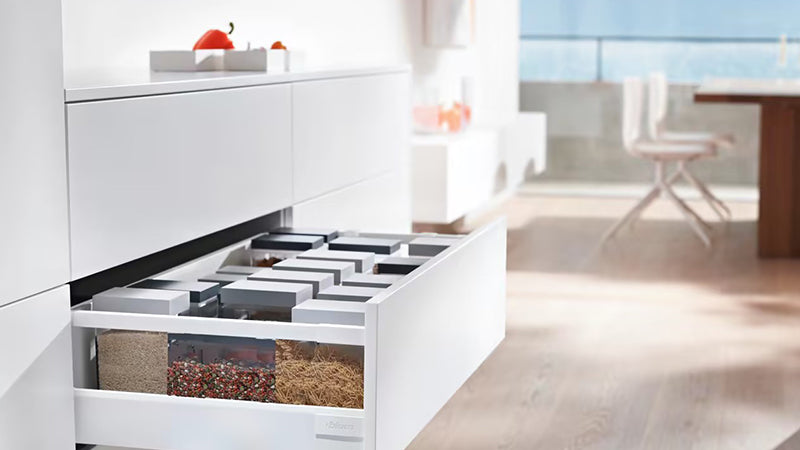
- Internal hardware and fittings — 15–22%: Hinges, drawer runners, pull-out baskets, soft-close mechanisms. The components most directly tied to daily experience quality.
- Handles and visible hardware — 5–10%: High visual impact; relatively low proportional cost. The easiest place to upgrade without significant budget increase.
- Installation labour — 18–28%: Often underestimated. Complex layouts, appliance integration, and non-standard wall conditions all increase this figure substantially.
- Site preparation and contingency — 8–14%: Plastering, electrical work, floor finishing at base. In older homes, this number trends toward the higher end reliably.
Spend More, Save Strategically: The Allocation Framework
✓ Worth the Premium
- Drawer runners and hinge quality — opened thousands of times annually
- Carcass material in high-humidity zones (near sink, dishwasher)
- Installation quality — a poorly fitted cupboard causes ongoing problems
- Internal organisation systems — pull-outs, dividers, adjustable shelving
- Door finish on the most visible cupboard runs
↓ Save Without Regret
- Door profile complexity — simple slab in quality finish beats ornate profile in cheap material
- Number of units — two well-specified towers outperform three mediocre ones
- Matching hardware throughout — one standout piece has more impact
- Upper cupboard quantity — fewer, better uppers with intentional open shelf moments
- Interior cupboard lighting in low-use zones
The Hidden Costs That Blow Kitchen Budgets
The gap between a quoted cost and a final invoice in modern kitchen cupboard projects is consistently larger than homeowners expect. The four most common sources of budget overrun:
Wall and ceiling preparation
Modern kitchen cupboards sit against real walls — which are rarely perfectly flat, plumb, or square, especially in homes more than 20 years old. Achieving a tight, professional fit often requires plastering, shimming, or scribing the cupboard panels to match irregular wall surfaces. In older homes, budget 10–15% of the cupboard cost for site preparation.
Appliance integration costs
Every built-in appliance in a modern kitchen cupboard run — oven, coffee machine, wine fridge, microwave drawer — requires a dedicated electrical circuit. Each circuit costs $150–400 to install before the appliance cost. Integrated refrigerators and dishwashers also require plumbing connections that are separate from the cupboard quote.
The second quote
Kitchens regularly require a second engagement that wasn't in the original scope: a different plumber to move the sink location, an electrician for additional circuits, a carpenter for structural modifications to accommodate a full-height cupboard run. These are not failures of planning — they're a function of what sites reveal during installation that drawings don't show.

Countertop and splashback coordination
Countertops are templated after cupboard installation — meaning their cost is confirmed only after the cupboard installation is complete. Material choices made early in the process (stone slabs, solid surface) can produce countertop costs that significantly exceed the cupboard budget itself.
Custom vs Semi-Custom vs Stock: The Cost-to-Outcome Ratio
For kitchens with standard dimensions and ceiling heights, semi-custom modern kitchen cupboards represent strong value — custom dimensioning within a defined range, quality finish options, without the lead time and cost of full bespoke. For non-standard configurations — low or high ceilings, angled walls, complex appliance integration — stock units produce visible compromises that fully custom manufacture resolves cleanly.
The cost premium for full custom manufacture over semi-custom typically runs 20–40% on materials. Against the 15–20 year lifespan of a kitchen cupboard installation, that premium equates to a modest annual cost difference — most easily justified when the kitchen layout genuinely requires it.
The Question of Value Over Time
The most rational framework for modern kitchen cupboard budgeting isn't "what can I spend now" — it's "what will this decision cost me per year of service life?" A cupboard installation lasting 20 years at $25,000 total cost represents $1,250 per year. The same kitchen done at $16,000 but requiring $5,000 in hardware replacement and surface repair at year eight represents comparable total cost with considerably more disruption.
Manufacturers whose products are engineered for longevity — and who back that claim with meaningful warranty coverage — represent better value over time than those whose price advantage comes from material or process shortcuts. That's a question worth investigating at the specification stage, not after installation.